
When Tempo Shifts Gears
(Or “When Songs Aren’t Always In A [Single] Mood”)
By Sean Ross
How do you code tempo and mood on a song that changes tempo eight times?
Phenomenal in every other way as well, “Driver’s License” by Olivia Rodrigo is slow, but with a pulse, when it begins. Its longest section is the 45-second bridge, slow but pulsating, that ends slow and acapella. In between, it goes through at least five other tempo changes. At various times, it could be both the slowest “1” and an airy “4.” It is definingly intense, but it is never hot.
Yes, analyzing a zeitgeist song in this manner invites mockery. (“Code it as a hit!” wrote one Facebook friend.) But radio programmers have a lot to negotiate these days. The song that opened slowly and dramatically was a standout in the days of “I Will Survive.” Now, it’s a formula. Even a song like “Sucker” or “Don’t Start Now” that is uptempo throughout is sparse at the outset, so it can further “kick in” during the first 30 seconds.
In a genre starved for tempo, there is a lot that merely tantalizes pop programmers—songs that are up, but never intense (“Go Crazy,” “34 + 35”); midtempo but at least bouncy (“Mood”); slow but rousing (“Bang!”). There are still the songs that are slow but busy (“Positions”) that were the core sound of Top 40 radio during its decline. And there is still enough somber music (“Lonely,” “You Broke Me First”) that those songs don’t have their traditional advantage of sounding like nothing else on the radio.
The hottest songs on the radio right now are “Levitating” and “Therefore I Am”—midtempo but bouncy and assertive. “Save Your Tears” is up, bouncy, but dour. The Weeknd’s “Blinding Lights” had its own brief wind-up but was close enough to traditional uptempo that radio powered it for a year. We have a lot of songs now that owe something structurally to “Don’t Stop Believin’,” perhaps our most enduring Classic Hit. “Don’t You (Forget About Me)” endures pretty well itself, but one wonders if it comes in too hot to be a hit now.
Like many things in radio programming, “do listeners notice?” and “does it matter?” are not the same question. “If we’re too low key, or frenetic, for their liking, they’ll punch out and not even really think about why,” says KLJY/KXBS St. Louis PD Mike Couchman. Listeners will only know that “they got bored, or we made them feel edgy, or whatever.”
“Sometimes I listen to pop radio and think no one even looked at the music before they loaded it,” says Brian Woodward. “Sloppy segues lately.” In this column, we’re all about attention to transitions.
Asked how they coded “Driver’s License,” most PDs defaulted to one of two methods. WWCK (CK105) Flint, Mich., PD Jerry Noble offers, “There’s the ‘how it starts and how it ends’ theory vs ‘how do you feel listening to it?’”
 “I’ve always coded them on the song as a whole,” says Justin Bryant of WMGB (B95.1) Macon, Ga. “The majority of ‘Driver’s License’ is medium tempo.” “I’ve coded ‘Driver’s License’ as slow, since the majority is slow,” says Michael Davis, owner/PD of Kentucky’s WMTA (Star 107.3).
“It’s all about how it starts and ends,” says Chuck Ingersoll. “Do whatever wild and crazy things you want in the middle, but let’s have some nice segueing and crossfades at the beginning and end, said the jazz show host.” (Ingersoll hosts a Sunday night jazz/R&B show on WGMC Rochester, N.Y.)
“I code it as slow,” says KFTZ Idaho Falls, Idaho, PD Viktor Wilt. “On my Active Rock station, I have a five- song separation for low-energy. There are too many low-energy new hit songs on Top 40 and Country to spread it out further than every-other-track from my experience, as much as I would prefer more energy overall in those formats.”
The late Canadian programming legend Pat Cardinal used to code only 1s and 5s. On his Classic Hits stations, Fleetwood Mac’s “Go Your Own Way” was a 5; “Dreams,” uptempo and emotionally intense, but never propulsive, was a 1.
In some ways, the recent changes in how hit songs are constructed makes it easier because a song like “Driver’s License” winds its way to the now customary cold ending. “Bohemian Rhapsody,” for all its changes, is easy to code—you wouldn’t want to play another ballad on either side of it. (It’s a minute shorter, and the changes aren’t operatic, but “Driver’s License” is, in many ways, this generation’s “Bohemian Rhapsody” in its structure.)
“I code based on mood,” says Impact Radio Boise’s J.D. Garfield. “Tempo can change throughout a song. The mood normally stays the same.” He avoids two “sad” songs back-to-back.
 “Unless there is a drastic change, I code tempo based on the intro. I also have mood coding,” says WJFX Fort Wayne, Ind., PD Rob Mack. “As far as tempo at radio now, sure there are ballads and slow songs, but I actually like our variety at CHR at the moment: Ariana, Pop Smoke, MGK, Olivia, AJR, Ava Max, Chris Brown, Dua Lipa, Bieber. That’s quite an array.”
Whether tempo matters will remain an open case for me until Top 40 and Adult Top 40/Hot AC put together a winning season without it. I’d be happy if programmers try to test the proposition this summer, have the right available product, and have an improving national mood to accompany.
Sean Ross is a veteran programmer, researcher, and the author of the Ross On Radio newsletter. Find him or subscribe free @RossOnRadio on Twitter. Contact him at rossonradio@comcast.net
Those Who Try Powergold Get It
Powergold users across the world rate us #1 in the industry for our ease of use, control of music flow, radio experience, and support and training. It’s time to discover Powergold and all the great things you’ve been missing.
Please fill out this form and we’ll reach out right away to schedule your demo.

 On Feb. 15, AC
  The EZ-to-Soft AC exodus was a big enough story to make page one of Billboard, or the front page of its radio section, at least four times in just over a two-year-period. In December 1988, I wrote that there had been a half-dozen major defections since June. Often these transitions were positioned by client-conscious radio station managers as “an evolution, not a revolution.”
 WJYE (Joy 96) Buffalo, N.Y., was relatively early among the format flips in late ‘88. Rather than downplaying its change, WJYE threw a client party where staffers put on a musical review for advertisers, including one song to the tune of “Mack The Knife” that began with “when the book bites.” PD Joe Chile, now back at the station in its current Soft AC incarnation as
 Every programmer should have the experience of scheduling an all-Christmas format at least once. You will never make as many listeners as happy as you will at the holidays. You will never see as much of your market gathered in one place either. Whether you miss having programmed radio in the ‘70s and ‘80s or missed the chance to program in that time of double digit shares, it’s a chance to see one station unify the market again. Even knowing that listeners are responding to the holiday, more than your individual programming choices, it’s still very gratifying, even if your job is just to wrap the presents.
 The U.S. Thanksgiving holiday, always the last Thursday in November, tends to mark the time when programmers ‘flip the switch’ to activate their Christmas Clocks. This can be full-on 24/7 all-Christmas, or a slow build – having worked out unwritten formulas that progressively introduce more and more Christmas songs per hour until they reach ALL Christmas on the 25th. Either way, it’s all controlled by programming clocks that are used for a relatively short period of time each year.
 The dramatic fast-to-slow segue is always one of the challenges of music scheduling. Do you let a tempo crash happen and try to finesse it with the presentational elements between the songs? Would you rather stairstep your way down over the course of several songs, perhaps making your Classic Hits station too slow, or your Adult Contemporary station too hot, in the process?
 Yes, some up-to-down segues sound great, especially if you’re going into a song with a dramatic opening. “Careless Whisper” always holds its own. The segues that make me happiest on the air are the up-to-down transitions that work, but one doesn’t remember them like the train wrecks.
 A few of programmers who were comfortable with Houston-to-Clapton were those in favor of using dramatic segues for effect. Veteran PD Pat Holiday recalled being told by Ronnie Stanton, now Corus national MD, that he used noticeable segues to make a tight library sound larger. “An amusement park roller-coaster without steep ups-and-downs and twists-and-turns is a pretty boring ride,” says WINK Fort Myers, Fla., PD Chuck Knight.
 “The goal of any AC station is to keep as many women listening for the longest possible time,” wrote former KSWD (The Sound) Seattle APD/MD Jeanne Ashley. “I always tried to curate for the one woman who was having the worst possible day. That particular segue is yet another emotional roller-coaster to her and shouldn’t happen.” Former KSWD PD Smokey Rivers adds, “I prefer single lane changes in tempo when decelerating.”
 Top 40 and Mainstream AC aren’t supposed to run on the same paradigm, of course. In ways other than power rotation, CHR has taken various programming tenets from AC and Country (particularly a blurring of the lines between current and recurrent), and I’m not sure that has helped either, particularly as the format tries to sort out how to acknowledge and rotate the many stories created by streaming. But our belief that listeners consciously want every format to be programmed for listenability over longer spans except CHR, Rhythmic CHR, and Hip-Hop/R&B, may reflect industry habit more than COVID-era usage.
 At the same time, I’ve also wondered which basic tenets of scheduling still matter. What’s AM/PM drive protection if there is, effectively, no AM or PM drive commute for so many people? I’ve never known for sure if listeners notice the same song in the 3 p.m. hour on consecutive Wednesdays, but it seemed like a reasonable thing to avoid when possible. But now listeners aren’t even sure if today is Wednesday.
 Two weeks ago, the “morning show until Noon” strategy got a further boost after the widely reported Edison Research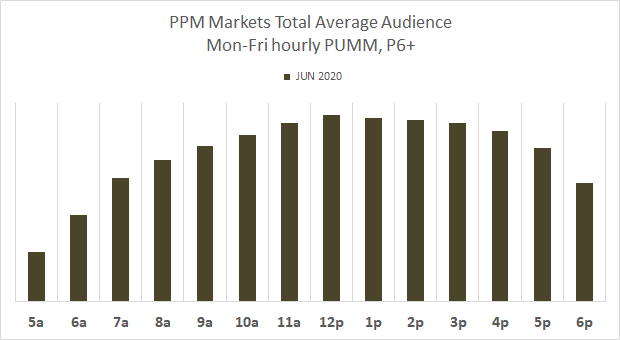
 That brings me back to the scheduling questions. In North America, consultants and programmers tell me that they’re not making a lot of changes in their rules or overall scheduling philosophy. They’re trying to provide continuity. As one consultant noted, continuity is the thing that radio can offer listeners now. To be fair, I’ve spoken to analysts and programmers I respect who think the all-morning morning show makes sense. But others see it as disrupting the one usage people are happy with.


 Thomas Giger is a European radio broadcasting specialist and publisher of Radio))) ILOVEIT, based in the Netherlands, and serving the radio industry worldwide.